
AI Meets the Metaverse:Building Worlds That Think Back
- Opening Scene: Entering a New Kind of World
- The Big Shift: From Virtual Worlds to Intelligent Worlds
- Notice your actions
- Learn your preferences
- Predict your needs
- Adjust the environment in real time
- The Brains Behind the World: How AI Shapes the Metaverse
- The Characters: Your AI Companions in the Metaverse
- Understand your emotional state
- Learn from your past interactions
- Remember your choices
- Adjust their tone and behaviour
- The Plot Twist: A World That Changes Because You’re in It
- The Journey: What We Can Build in the AI-powered Metaverse
- Education: Personalized learning adventures.
Instead of textbooks, students explore interactive simulations. The difficulty curve adjusts individually, ensuring no one is left behind. - Work: Smarter Virtual Offices
Imagine walking into a VR meeting room where AI summarizes yesterday’s work, sets up your tools, and highlights important tasks before you even ask. - Retail: Intelligent Storefronts
Virtual malls could offer personalized trials, automatic styling tips, and interactive product demos that react to your interest in real time. - Gaming: Endless, Evolving Worlds
Games become infinite. Environments and missions regenerate and shift depending on how you play. - Social Spaces: Healthier Digital Communities
AI moderates behaviour, reduces toxicity, encourages positive interactions, and builds safer, more inclusive spaces. - Behind the Curtain: The Tech Stack That Makes It Possible
- 3D Engines + AI Frameworks
Tools like Unity, Unreal Engine, and custom AI layers create immersive environments that respond instantly - Cloud + Edge Computing
These systems allow complex AI models to run in real time without slowing down the experience. - Blockchain Identity Layer (Optional)
Decentralized identity helps users keep their data, assets, and identity consistent across worlds. - Multi-Agent Coordination
This is where multiple AIs work together, NPCs, world logic, environment generation, creating a synced digital universe - The Conflict: Challenges We Must Solve
- Privacy & Data Ownership
Thinking worlds need data. The question is: who controls it? - AI Hallucination Risks
Generative systems may produce errors or unrealistic behaviours that break immersion—or create misinformation. - Safety & Moderation
With adaptive worlds, we need strong systems to manage harassment, manipulation, or harmful behaviour. - Ethical World-Building
Who decides the rules inside an AI-driven world?
Who governs AI societies? - Hardware Limitations
Not everyone has access to high-end devices needed for full immersion. Accessibility must evolve too. - The Future Scene: What “Thinking Worlds” Will Look Like in 10 Years
- You'll have a persistent AI companion that exists across all worlds—your digital shadow.
- Virtual cities will run on autonomous AI, handling traffic, governance, events.
- Entire societies inside the Metaverse will be run by algorithms adjusting policies in real time.
- Mixed reality will blur the lines so much that physical and virtual life feel like one continuous space.
- Closing Note: A World That Grows With Us
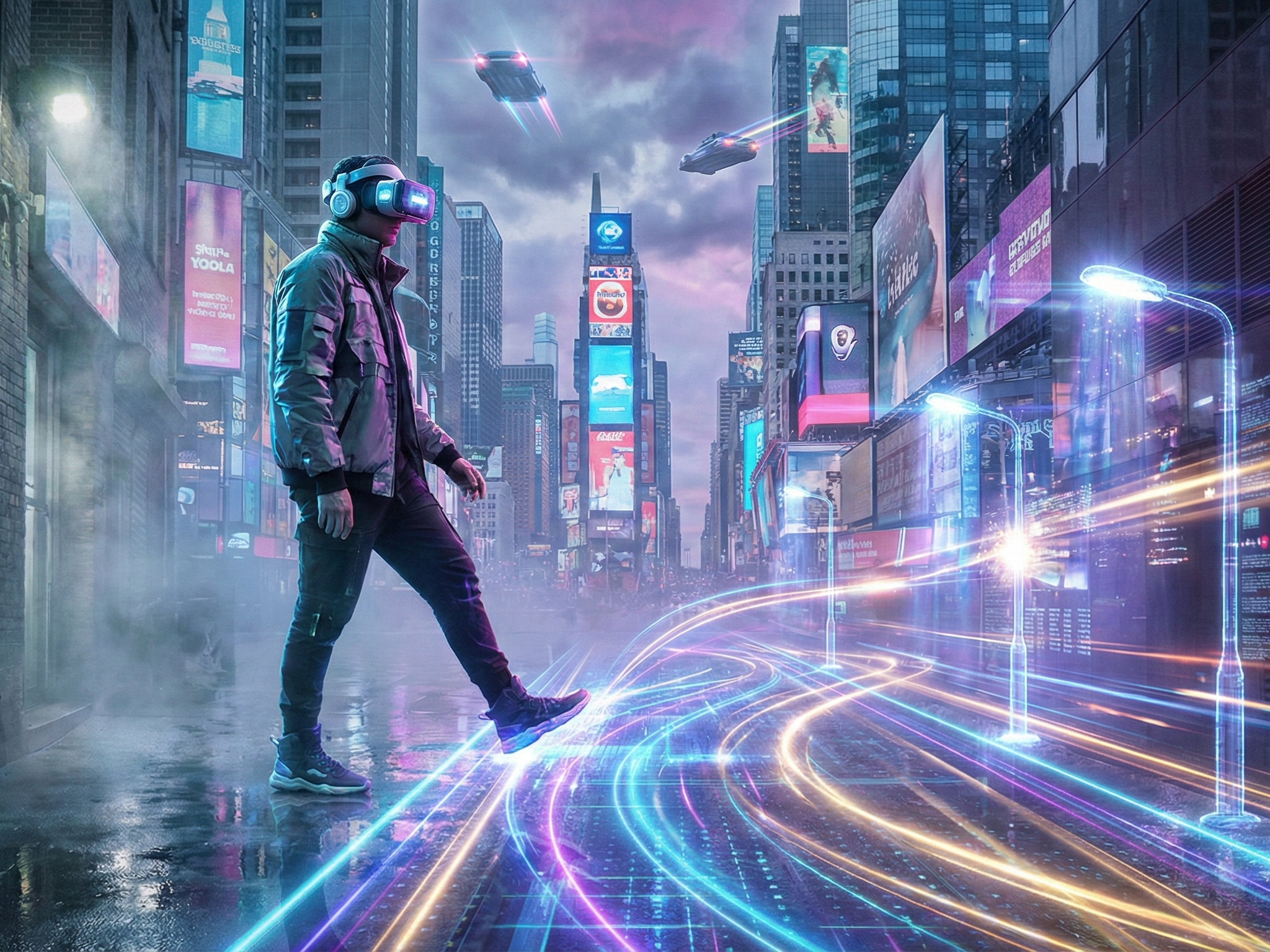
Imagine this, you put on your headset and step into a virtual city. But this time, something feels different. The moment you enter, the world notices you.
The streets brighten because you prefer well-lit spaces. A friendly character walks up and says, “Hey, you were halfway through that quest yesterday. Want to continue?” The music in the background shifts to your favourite genre without you touching a single setting.
"This isn’t just a virtual world. This is a thinking world"
The Metaverse we once imagined—static maps, fixed missions, stiff NPCs, has started to evolve. And the force pushing it forward is AI. It’s turning digital spaces from pre-built playgrounds into living ecosystems that adjust, react, and grow with every step you take.
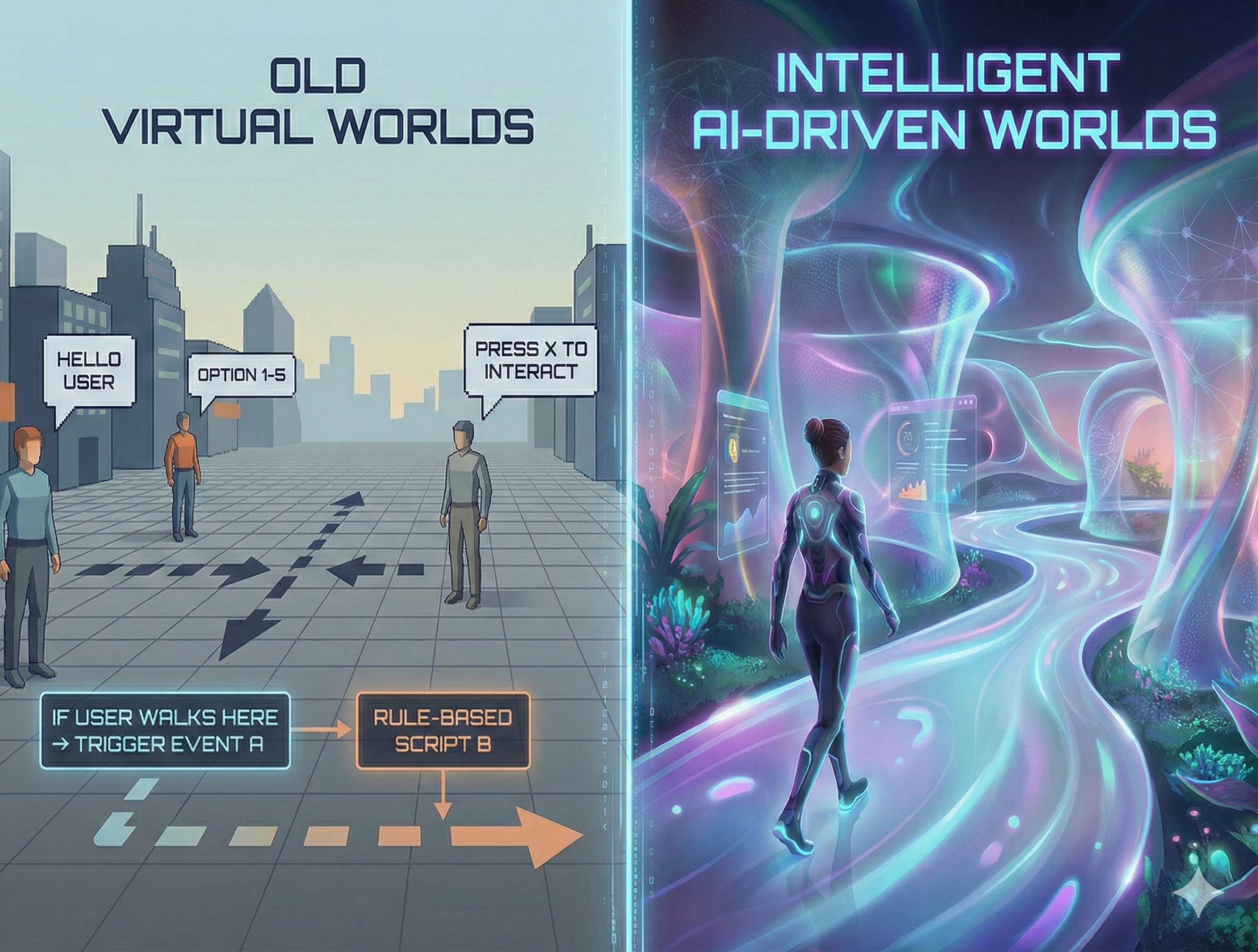
Back in the day, virtual worlds worked like board games. Every action had a pre-written rule. If you walk here → this happens. If you say this → the system gives one of five canned responses.
Predictable. Scripted. Repetitive.
But AI flips the entire model. Instead of following rules, these worlds learn. They don’t wait for fixed triggers, they observe your behaviour and adapt on the go.
This is where the concept of “thinking worlds” comes in.These are spaces that:
The Metaverse is no longer a place you enter. It’s a place that responds.
The magic of thinking worlds comes from multiple branches of AI working together like organs inside a digital body.
Computer Vision: Worlds That See
Cameras and sensors help the system understand your gestures, movements, facial expressions, even micro-emotions. The environment can greet you, mirror your mood, or adjust your surroundings based on how you look or behave.
Generative AI: Worlds That Build Themselves
Want a forest? Want it in Japanese watercolor style?
Want the trees to react to your footsteps?
Generative AI can create new environments, objects, or even avatars instantly, no human designer required.
NLP + Voice AI: Worlds That Talk Back
The era of stiff NPC lines is gone. AI enables conversations that feel natural, unscripted, and personal. You talk. They understand the meaning, not just the words.
Reinforcement Learning: Worlds That Evolve
RL helps digital environments learn from millions of interactions. If users struggle, the system adjusts. If they exploit something, it fixes itself.
Digital Twins + Simulation: Worlds That Mirror Reality
From realistic traffic patterns to true-to-life weather, digital twins bring real, world logic into the Metaverse—making virtual spaces behave like believable ecosystems.
NPCs are no longer robots repeating the same lines. With AI, companions can:
These companions aren’t just assistants. They're guides, friends, mentors, or even co-workers inside the Metaverse. Over time, they become personalized extensions of your digital life, making each session feel uniquely yours.
Here’s where it gets wild, the world doesn’t just exist for you. It shifts because of you. A few examples:
Learning Spaces That Transform
If a student struggles with a topic, the environment changes. Puzzles become simpler, hints appear, and the pace adjusts automatically.
Retail Spaces That Curate
Virtual stores rearrange product shelves based on your style, past purchases, or what you paused to look at..
Work Simulations That Predict Your Needs
Imagine a virtual workplace that changes workflows, assigns tasks, or adapts meetings depending on your productivity patterns.
These aren’t scripted scenes. These are dynamic storylines shaped by your presence.
Now let’s talk about real-world use cases—stuff happening now or right around the corner
You don’t need to be a techie to get the basics.
Every good story has tension.
Here’s ours.
Fast-forward a decade
We won’t just visit intelligent worlds.
We’ll live in them.
We often talk about AI and the Metaverse as two separate revolutions. But the real magic happens when they merge.
When worlds don’t just host us, but learn from us.
When characters don’t just act, but understand.
When environments don’t just exist, but evolve.
The future isn’t about choosing between the Metaverse or AI.
It’s about building worlds that grow with us, worlds that think back